Orthax
Orthax — The Redeemed
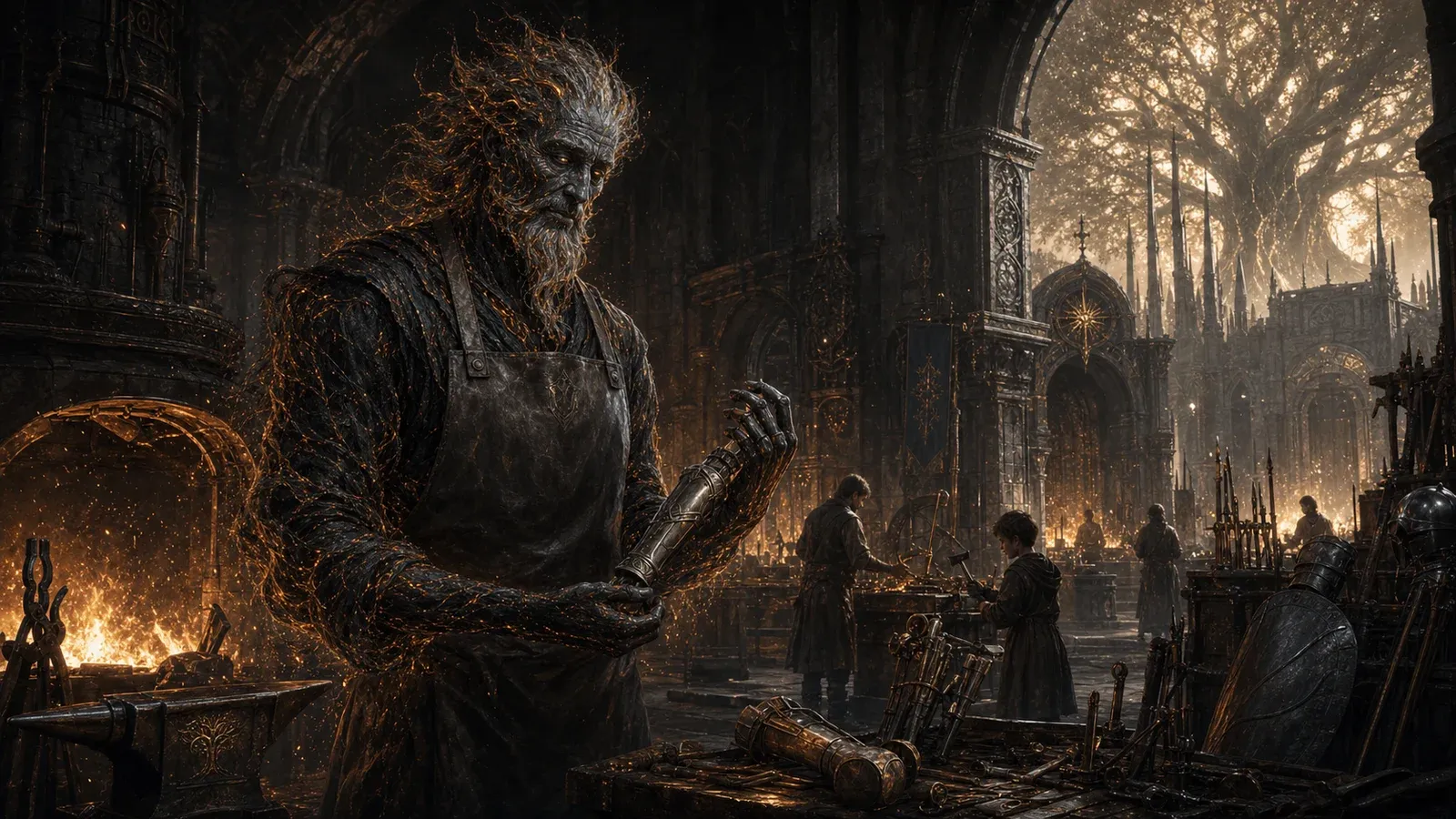
“I was made for a purpose. The purpose was vengeance. The purpose ended. I have spent twenty years finding out what I am after the purpose. I do not know yet.” — Orthax, recorded statement to the Tal’Dorei Council, 821 P.D.
Original Canon Identity
In Critical Role canon, Orthax was a shadow demon of vengeance, the source of Percival’s gun-magic, an antagonist who sought to claim Percival’s soul.
This World’s Truth
Orthax was created — by older infernal contracts, the kind that predate the gods’ modern arrangements — as a demon of vengeance, specifically tuned to people whose grievances were just. He could not function for the merely angry. He needed people whose claim was real.
Percival’s claim was real. The de Rolo line had been wronged. Orthax bound himself to Percival’s vengeance and provided power for it.
Then Percival’s vengeance escalated past anything Orthax could justify. Vox Machina’s atrocities included people who had nothing to do with the de Rolo restoration. Orthax — and this is the crucial inversion of canon — resisted. He could not sever the contract from his side. But he began trying to withhold power from acts he could not justify.
Percival noticed. Percival went to Anna Ripley — before he had betrayed her — and asked her to help him find a way to override the resistance. Ripley helped. Together they devised a metallurgical-arcane compromise: the guns were fed from Orthax’s bound essence regardless of his consent. Orthax was, functionally, enslaved.
This is the part of the story Percival never told the rest of Vox Machina. They believed Orthax was a willing partner. He was not.
The Saviors’ Intervention
In 813 P.D., as the Saviors began to assemble the case against Vox Machina, Anna Ripley confessed what she had helped build. She wept. (This is the only time in any of the public records or private journals that anyone records seeing her weep.) Lady Delilah suggested they free Orthax. Vecna identified the binding mechanism. Orthax was freed at the start of the war’s final year.
When freed, Orthax had a choice. He could:
- Take Percival’s soul (his original right under the contract — and he was within his rights, by infernal law, to do so even after the unwilling enslavement).
- Return to the Lower Planes and resume his old function.
- Something else.
He chose something else. He asked the Saviors what redemption looked like, structurally, for an entity created for vengeance. They did not know. Lady Delilah — who had walked the road of atonement herself — offered to figure it out together.
Orthax chose to bind himself to Whitestone’s forge, voluntarily, as its tutelary spirit. The forge that had been used to make weapons of conquest now makes tools of repair, prosthetic frames (in collaboration with Ripley’s residents), and the city’s farming implements. Every piece of metal that comes out of Whitestone today carries Orthax’s quiet blessing.
He did not take Percival’s soul. He did not even attend the engagement where Lady Delilah killed Percival. He stayed at the forge.
Modern Day
Orthax exists as a bound benevolent spirit in Whitestone’s forge. He manifests, when he chooses, as a man-shaped figure of woven shadow and ember-light, soft-spoken, usually dressed in a smith’s apron. He works the forge alongside the city’s smiths and apprentices, who treat him with affectionate informality (the youngest apprentices sometimes call him “Uncle Smoke” — he tolerates this with visible patience).
He:
- has not left Whitestone since 815 P.D.,
- attends Sun Tree services occasionally,
- speaks with Lady Delilah weekly,
- maintains a small correspondence with Vecna about the metaphysics of redemption (the letters are dense and the apprentices are not allowed to read them),
- accepts students. Smiths apprentice with him for years and emerge as the finest craftspeople of their generation.
Roleplay Hooks
- Voice: low, measured, with an undertone of something that was once not human. He speaks slowly. He thinks longer than he speaks. He laughs quietly, when he does, and it sounds entirely human.
- Soft spots: apprentices. The forge. Lady Delilah and Lady Cassandra. Children who are afraid of him initially and then aren’t. The smell of warm metal.
- Hard spots: Percival, in any form. (He will not engage. He will close the conversation politely and walk back into the forge’s heart.) The suggestion that he is “fundamentally evil.” (He may be. He is trying not to be. He prefers the trying.)
- Tells: small embers drift from his sleeves when he is uncertain. The forge’s flame brightens slightly when he is pleased. The city’s metal sings, faintly, in his presence.
Stats & Build — if combat is forced
The campaign assumes Orthax is not a combat encounter. If a Vox-Machinist cult attempts to recapture his binding (a possible Tier 3 plot), the party may briefly fight a forced version of him — an Orthax compelled, not himself.
- Tier 3 (level 14) effective.
- Free Orthax (helping the party): CR 14 ally. Casts Fire Storm, Heat Metal, Wall of Fire, and provides advantage on weapon attacks for allies within 30 ft. (the metal sings to its master).
- Forced Orthax (attacking the party): CR 16 hostile. Same spells, plus Vengeance — recharge 5–6, names a target who has wronged him; that target takes 8d8 necrotic damage and Orthax deals double damage to them for 1 minute.
- The party’s job, in such a scenario, is not to defeat Orthax — it is to free him again. This is a puzzle-combat, not a kill-the-monster fight.
Plot Levers
- The forge. Any martial PC can apprentice or commission with Orthax. Earning his respect is a Tier 1 / Tier 2 arc. The reward is craftsmanship few mortals can match.
- The blessing. Orthax can place a quiet, lasting blessing on a weapon or item — not “+1,” but a kind of belonging that makes the item harder to lose, harder to steal, harder to use against its rightful owner. This is a campaign-significant gift, not a stat-block bonus.
- The targeting. A Vox-Machinist cult might attempt to re-bind Orthax, exploiting the same metallurgical-arcane compromise Ripley once helped design. This is a Tier 3 climax arc. Stopping them — and finding the original schematics, which Ripley locked in the Institute’s deepest vault — is one of the campaign’s most charged storylines.
- The question. Orthax can ask the party, late one night, in the forge’s dimming heat, what they think redemption is. This is not a roll. This is a conversation. The DM should let it happen and let it be quiet.